
Gaston Dubois was born in 1911 in the small town of Reims, nestled in the heart of France. Raised in a family of winemakers, Gaston spent his early years among the vineyards, dreaming of a peaceful life. However, the idyllic life he envisioned was shattered by the Russian occupation of France following the First Great War. His father, a veteran of the French army, was executed for resisting Russian control, leaving Gaston and his younger sister, Claire, to fend for themselves in a world dominated by oppression.
From a young age, Gaston grew to despise the Russian Empire and its puppet government in France. He joined the French Resistance as soon as he was able, quickly earning a reputation for his determination, resourcefulness, and unrelenting loyalty to the cause. Gaston’s knowledge of the countryside made him invaluable for smuggling weapons and supplies, and his courage in the face of overwhelming odds made him a natural leader within the resistance.
By 1940, the resistance faced an impossible enemy: Rasputin’s Warriors of Divinity and the might of the Russian war machine. Conventional weapons and tactics were proving futile, and desperation grew among the resistance leadership. It was during this time that Gaston encountered Thaddeus Myles Stein, the German scientist who secretly opposed Rasputin’s rule. Stein, now working with the French Resistance, proposed a radical plan to create enhanced soldiers capable of combating Rasputin’s forces.
Gaston volunteered without hesitation, knowing the risks. He understood that the fight for France required sacrifices, and if his own humanity was the price, he would pay it willingly. Stein’s experiments combined advanced technology with chemical alchemy, using forbidden knowledge stolen from Rasputin’s laboratories. The goal was to transform Gaston into a living weapon—a soldier who could emit deadly poisonous gas to incapacitate enemies en masse.
But the experiment went horribly wrong. Gaston’s body was completely consumed by the alchemical process, transforming him into a being composed entirely of toxic gas. His physical form dissipated, leaving only a swirling, semi-conscious mass of vapor. While he had gained the terrifying ability to release deadly clouds of poison at will, he could no longer interact with the material world and was at constant risk of dissipating entirely into the atmosphere.
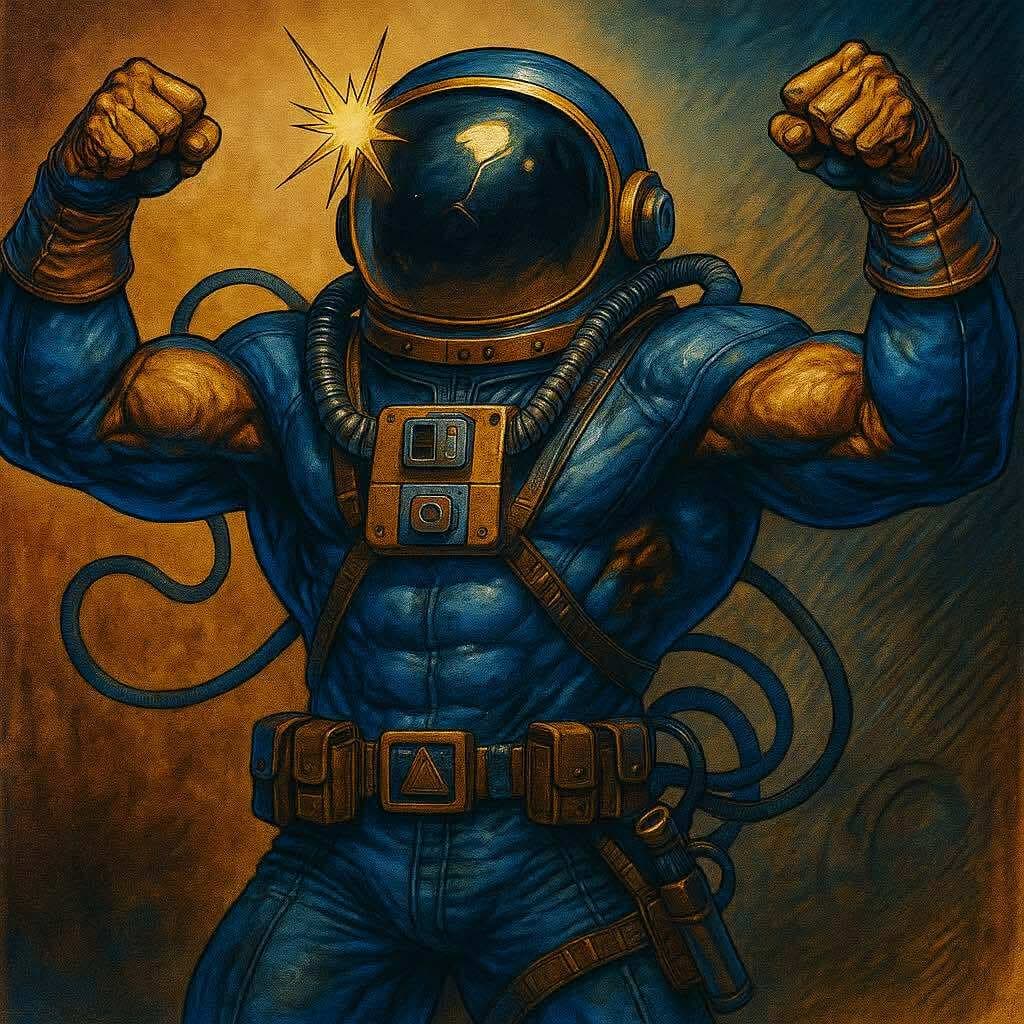
To save Gaston from fading away, Stein developed a specialized containment suit. Constructed from a combination of advanced alloys and mystical seals, the suit allowed Gaston to maintain a cohesive form, interact with the physical world, and control the release of his poisonous abilities. The suit became Gaston’s new body, a lifeline that anchored his consciousness and prevented his gaseous form from dispersing into nothingness.
The suit’s design was both practical and intimidating. A deep black with glowing green accents, it resembled a hazmat suit crossed with a knight’s armor. The helmet featured a reflective visor, obscuring what little remained of Gaston’s face, and intricate seals across the chest and arms pulsed faintly with arcane energy. A filtration system allowed Gaston to control the release of his poison, expelling concentrated clouds of gas through vents in the suit’s arms and back.
The suit gave Gaston a second chance to fight for his homeland, but it also served as a constant reminder of the price he had paid. No longer truly human, Gaston struggled with his identity, grappling with the isolation and despair of his new existence.
Now known by the codename “Miasma,” Gaston became one of the French Resistance’s most powerful weapons. His ability to release clouds of deadly poison allowed him to decimate enemy forces, clear out heavily fortified Russian positions, and sabotage supply lines. However, his powers also made him a figure of fear, even among his allies. The sight of Miasma stalking the battlefield, his suit hissing with toxic vapor, became a symbol of vengeance against the Russian occupiers.
Despite his fearsome abilities, Gaston remained loyal to the ideals of the resistance. He fought not for revenge, but for freedom and the hope that future generations might live without the shadow of tyranny. His containment suit allowed him to continue working alongside his comrades, though it came at great personal cost. Gaston’s new form made him feel alienated from those he fought to protect, and he struggled with feelings of loss and loneliness. Only Élise LaFleur, the leader of the resistance, seemed to truly understand his pain, often reminding him that his sacrifice had given their movement the strength to continue.
Gaston serves as both a front-line combatant and a specialist in sabotage missions. His unique abilities make him ideal for ambushes, disrupting Russian forces, and neutralizing enemy fortifications. However, his presence is also a stark reminder of the sacrifices the resistance must make to stand against Rasputin’s empire.
Gaston often works closely with Henri LaFleur, who appreciates his stealth and precision. Together, they form an unstoppable team, infiltrating Russian-controlled areas and leaving chaos in their wake.
Though Gaston has sacrificed his physical form, his spirit remains unbroken. He fights for the memory of his family, for the liberation of France, and for the hope that one day, the horrors of Rasputin’s rule will end. Despite his struggles with his new existence, Gaston clings to the belief that his sacrifice was not in vain—and that even a man turned to poison can bring new life to his homeland.