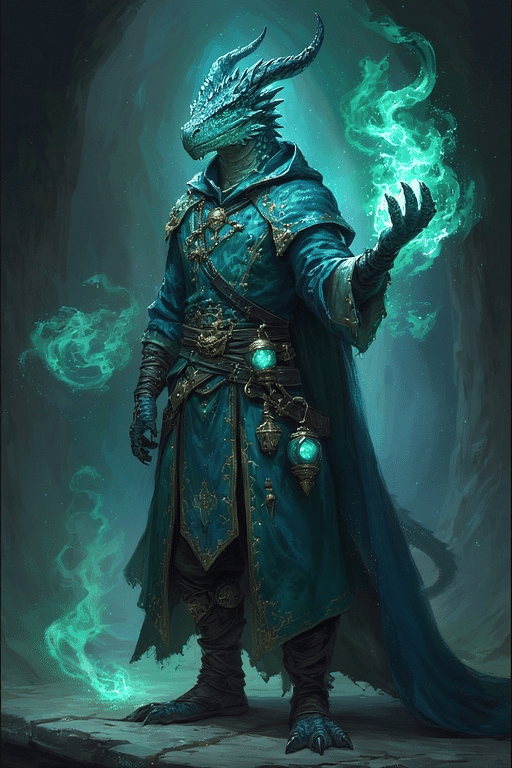
Pyrrhus was born on the Moonveil Strand of Draemir, where silver‑laced sands gleam under the moonlight and the mists carry both trade and curse. His father was a drakona of the coastal clans, his mother a wandering elf who never stayed long in one place. From the beginning, Pyrrhus was caught between worlds.
He bore the scales and stature of the drakona, but none of their elemental breath. His features were sharper, more angular, marked by elven blood. He did not sleep as his kin did, and whispers spread that his lifespan might stretch unnaturally long. Among the drakona villages, he was tolerated but never embraced—too strange to be one of them, too rooted to be a wanderer like his mother.
Seeking to fill what he lacked, Pyrrhus turned to alchemy, first as a craft, then as a calling. He painted glyphs across his scales, each line a ward or enhancement, each stroke requiring rare pigments and costly reagents. His armor was not forged of steel but inscribed upon his own body, a living script of protection and power.
When Draemir’s coinbinders and alchemists could teach him no more, he followed his mother’s example and became nomadic. He wandered through Duskwatch’s mountain passes, learning to distill herbs that warded against geist‑sickness. He studied in Valgard’s parishes, where the Church’s inquisitors taught him how to sanctify tinctures with holy water. He even braved the edges of Gräuhaven’s Schattwald, harvesting wolfsbane and moon‑touched fungi under the watch of the Vale Watch.
Everywhere he went, he stayed only long enough to learn, then moved on.
It was in Valgard’s haunted parish of Mournhollow that his fate turned. In his endless search for new reagents, Pyrrhus harvested from a monstrous creature he thought to be a corrupted beast. He brewed its essence into a potion and, as was his custom, tasted it himself. Only afterward did he realize the truth: the creature had been a vampire.
The draught burned through him, reshaping him. His elven blood softened the curse, but it did not spare him. He became what he had studied, what he had feared—a vampire, though one born not of fang but of alchemy’s folly.
Wandering westward, Pyrrhus met Mike O’Riza, an ooze‑born being who believed himself cursed by his own strange “upbringing.” Pyrrhus saw in him a reflection of his own fractured nature. Where Pyrrhus sought balance through alchemy, Mike sought purpose through dissolution. Together, they complemented each other’s needs and forged a bond.
They traveled until they reached the southern forests of Gräuhaven, where they founded Crow’s Hollow, a settlement hidden among the trees. It became their refuge, a place to return to after each journey into the cursed provinces.
In Crow’s Hollow, Pyrrhus met others drawn by fate and shadow:
The Traveller, a man who never gave his true name, but whose knowledge of the old roads and ruins was uncanny.
Travian Bloodtainted, another half‑elf vampire, who turned his curse into a weapon against his own kind, raising the dead to hunt the undead.
Pyrrhus remains a wanderer, but Crow’s Hollow is his anchor. He paints his glyphs anew when they fade, each line a reminder of the cost of his craft. He brews potions that heal and poisons that kill, walking the line between salvation and damnation.
He is drakona without breath, elf without rest, alchemist without restraint, vampire without sire. In a land where every soul is trapped, Pyrrhus has made peace with his paradox: he is not whole, but he is useful. And in Wachovia, that is enough.